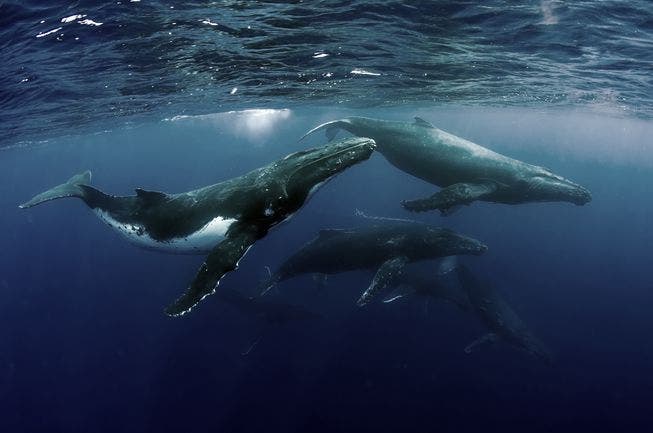
It’s rainy season. A magical time of lush, dense forest; thunderous storms; ponderous and unpredictable rainfalls; choirs of belching toads; incredible sunsets of orange, red and purple; and glassy, perfect waves (storms permitting). Just when you thought that things could not be any more perfect…. The humpback whales arrive!
The first I heard of their arrival was under water. It was early August. Whilst exchanging pleasantries one morning with a friend in the water, he asked me ‘Did you hear the whales?” No! I immediately slid off my surfboard and dunked my head. And there it was, the mysterious and enchanting sound of the whale song.
In August and September, whale spotting is almost a daily occurrence for those out on the ocean. It is the best time to see them, either with one of the local fishing boats or with the Iguana Divers. A couple of weeks ago I went diving with the Iguana Divers (a highly recommended experience… but more about that in another blog post!) and we spotted a mother humpback whale with her calf. It is an incredible experience to see these huge, graceful creatures from so close.
There are actually three distinct global populations of humpback whales, which some scientists believe should be considered to be distinct species that are evolving independently.
- Southern hemisphere humpback whales – with an estimated population of 50,000;
- Northern hemisphere humpback whales – est. population 18,000 to 20,000; and
- North Atlantic humpback whales – est. population 12,000
The whales that are visiting our coasts right now are the Southern Hemisphere Humpbacks. From August to November they migrate from their summer feeding grounds in the Antarctic to the warmer waters off the Pacific Coast of Panama and Costa Rica. That’s a migration of over 5,000 miles (or 8,000 kilometers). Approximately 2,000 of the Southern Hemisphere Humpbacks arrive in our waters to mate, give birth and nurse their calves.
Here are some interesting facts about these amazing, enormous and gentle creatures:
- A fully gown male humpback whale measures 13-14m (43-46ft). The females are slightly larger at 15-16m (49-52ft)
- The Southern Hemisphere Humpback Whales migrate 5,000 miles from their feeding grounds in the Antarctic in order to mate in the warm waters off the Central American Pacific Coast. The females then return 11.5 months later to give birth, to nurse and raise their calves.
- Newborn calves measure 6m (20ft) and weigh 1.8 tons. They nurse for about six months, before being slowly introduced to independent feeding. Humpback whale milk is 50% fat and pink in color.
- During the months that they breed, nurse and play in the tropics, the humpbacks live mostly off their fat reserves. They do not properly feed until they return to the polar waters, where they feed on krill (small crustaceans).
- The lifespan of a humpback whale is between 45 and 100 years.
- The humpbacks are famous for the complex songs sung by the males. The songs can last up to 20 minutes and are repeated for hours on end. Scientists are still mystified by the Whale Song – some believe that it plays a role in mating rituals, whilst others believe that it is used for echolocation. The songs are long and complex. Every male whale within each of the three global populations sings the same song, no matter how far away they are from each other. And each population’s song changes slowly over a period of years without repeating.
- The humpback whales were hunted to the brink of extinction before a global ban on hunting was introduced in 1996. By that time, the global population had been reduced to only 5,000 individuals! Thank god that the International Whaling Commission (IWC) was created and stepped in to prevent the extinction of these incredible, intelligent and fascinating creatures.
- Thanks to the ban on hunting, the Southern Hemisphere Humpback Whales have now recovered to an estimated population of 50,000. There is still a long way to go for the whales to recover to their pre-hunting population of 125,000.
If you do go on a whale watching tour, please remember that it is illegal in Costa Rica to swim with dolphins or whales. And make sure your tour guide is familiar with the Whale Watching Guidelines published by the SINAC.
Below is a wonderful sequence captured by the Iguana Divers:






Responses