Highlights
- Barefoot Mornings, Tree-Top Afternoons
- Learning That Doesn't Feel Like Learning
- Childhood Shaped by Community, Not Isolation
- The Farm That Feeds, More Than Meals
- Freedom That's Held By Nature, Not Fences
- Evenings - As the Sun Goes Down
- A Childhood That Remembers Connection
- About The Author
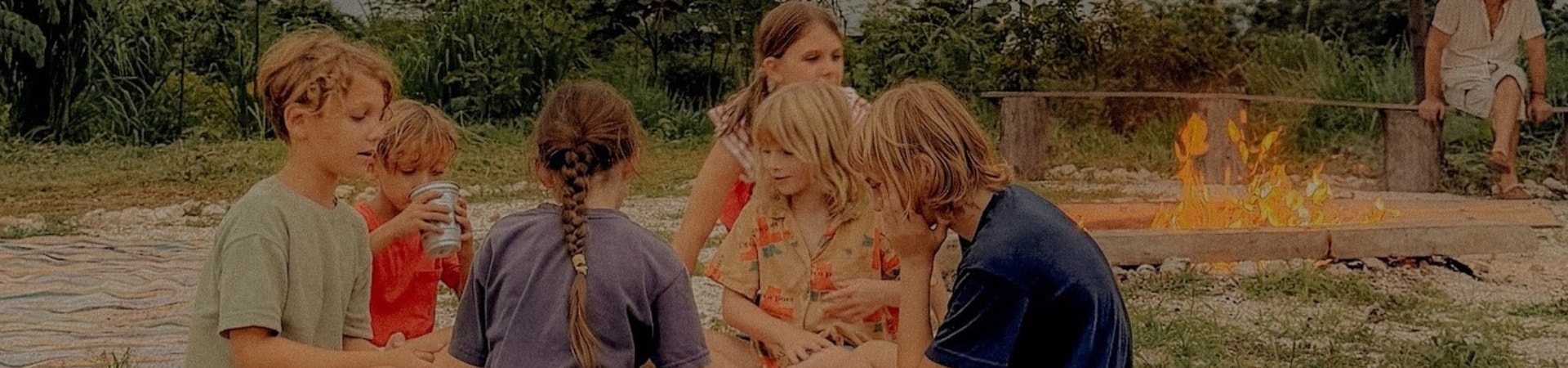
Some mornings in the hills above Santa Teresa start with a peace that you don't find in cities anymore. It's a quiet that feels alive. Birds call across the canopy, the breeze softly rustles through the trees, and kids stroll with bare feet on warm wooden floors before the adults even wake up. Childhood at The Ark doesn't happen through rigid schedules, car rides, traffic or in crowded spaces. Instead, it unfolds through open space, discovery, and the gentle rhythm of nature.
You notice this as soon as you step into the community: children move differently here. Their shoulders relax, their hearts are free. Their steps feel lighter. The questions they ask are bigger and somehow more grounded. They're not rushed from one activity to another. Instead, they play, explore, connect, get dirt under their fingernails, and learn from the world around them rather than from a screen.
Every family comes to The Ark for different reasons—a change in lifestyle, a healthier life, a need for safety, a desire for community, or the search for something meaningful. Yet, one common thread connects them all: they want their children to feel the world, not just pass through it.
Barefoot Mornings, Tree-Top Afternoons
A typical morning begins with sun slipping through the hills and lighting up the roads that weave through the community, homes, gardens, and the farm. Kids spill out early, often barefoot, often laughing, chasing each other toward the playground, exploring the farm and the fruit trees or searching for whatever creature they spotted the day before. The whole project in a sense is their playground, the entire 80 hectares become one giant living classroom. Fallen branches turn into bridges. Tree stumps become pirate ships. A smooth stone found near the trail becomes a treasured object with its own invented mythology. At sunset the firepits become places to tell stories of adventure and sign songs. Parents here often talk about how quickly their children's sense of freedom expands. How a child who once hesitated at the edge of a park now scrambles up the hillside without a second thought. How confidence blooms when nature becomes the playground and classroom where children are immersed, instead of something distant, something reserved for weekend trips.

There's a kind of easy bravery that develops when you grow up this close to the earth.
Learning That Doesn't Feel Like Learning
In the middle of the community, shaded by tall trees and open to the breeze, sits ARKADIA — the learning space where Montessori-inspired exploration blends with jungle discovery. Classes may begin with books and materials, but they often flow outward: into the farm to observe how water moves through the soil, into the forest to study textures and sounds, into the garden beds where children help plant, water, and harvest.
The teachers talk less about ''subjects'' and more about curiosity. Some days are spent making art from leaves and branches. Some days revolve around storytelling or music. Some days shift into science because a child noticed a butterfly with unusual wings and the whole group became fascinated.
And because the community is filled with families from different countries, languages weave in and out naturally — Spanish, English, French, German. Children grow up hearing accents, tasting dishes from different cultures, learning empathy from real relationships, not lessons printed on posters.
Here, diversity isn't a curriculum module; it's the shape of daily life.

Childhood Shaped by Community, Not Isolation
The social fabric at The Ark isn't built around forced playdates or structured programs. It's built around proximity, shared purpose, and real collaboration. Kids are free here. Parents help each other out, they share tools, recipes, and time. Meals at the community kitchen become informal gatherings where stories spill across the table and children share whatever they harvested or helped bake or prepare that week.
Something subtle happens in this environment: children learn what belonging feels like. Not through rules or speeches, but through experience—seeing adults work together, solve problems, make space for one another, laugh together after long days. They see community not as an event, but as a way of living. When a child grows up seeing adults cooperate like that, their sense of what's possible widens.
The Farm That Feeds, More Than Meals
At the heart of The Ark sits the farm, 6 hectares lined with permaculture beds, fruit trees, herbs, medicinal plants, and quiet moments that become childhood memories. Kids here don't just learn that food “comes from the supermarket.” They learn how soil smells when it's healthy. How compost warms as it breaks down. How a tomato tastes when it's handpicked, sun-warmed, and eaten right there, still carrying the scent of the vine.

There's an unspoken pride in children who can explain the difference between healthy soil and depleted earth. Who can identify medicinal plants before they can spell them. Who understand that growing food is an act of care and patience.
Watching kids carry baskets bigger than their torsos, filled with fruits and veggies they harvested themselves, is the kind of image that stays with parents long after the day is over.
Freedom That's Held By Nature, Not Fences
In many places, freedom means risk. Here, freedom is supported by landscape. Children ride bikes freely, they explore trails, climb trees, and explore tidepools filled with life. They learn to assess their surroundings, trust their steps, and listen to their instincts.
And because parents live within close-knit clusters, there's always an adult nearby — not hovering, not controlling, but aware. Safety comes from presence and community, not restrictions.
This is one of the reasons families from around the world are drawn here. It's not escapism; it's a return to something essential: the idea that children thrive when they're connected to the world, not shielded from it.
Evenings - As the Sun Goes Down
As the sun begins to drop into the Pacific, families wind down. Sometimes it's music drifting from the shala. Sometimes it's a slow walk down the path as the sky turns soft orange. Sometimes it's kids playing a last round of hide-and-seek while adults chat under the trees. And on clear nights it may be a blanket on the lawn set up for stargazing. The pace is slower, but not in a passive way — slower in a mindful, full-bodied way. The kind of slow that lets kids process their day instead of rushing through it. Parents often say evenings here feel more like exhaling than ending.
A Childhood That Remembers Connection
When people talk about childhood memories, they remember sensations — sunlight on skin, diving into the ocean, the feeling of climbing a tree for the first time. Life at The Ark naturally creates those memories because it prioritizes experience over performance, presence over pressure.
Ask any parent living here and they'll tell you the same thing, their children are calmer, more curious, more grounded, and more confident.

Not because the community teaches those traits directly, but because the landscape and lifestyle allow them to grow naturally.
Growing up in the hills above Santa Teresa isn't a retreat from the world — it's an immersion into a richer version of it.
If this way of living speaks to you, you're welcome to visit The Ark, the school, the farm, and see how children live and learn here.
About The Author
Hi, I'm Jen Harter. For over 10 years, I've been helping people discover the Santa Teresa area and the Nicoya Peninsula—the beaches, the mountains, the quiet corners, and the hidden gems that make this part of Costa Rica feel like home.
Whether you're thinking about relocating, investing, or just daydreaming about life in paradise, I'm here to answer your questions and share what I've learned from living and working here. With offices across the country, I can also connect you with the right people if your curiosity takes you beyond Santa Teresa. There really is so much to explore.
I'm not here to push a sale. I want to give you honest insight, local perspective, and the space to figure out if Costa Rica really feels like the right fit for your next chapter. For many, the decision takes time—and that's perfectly okay. That's exactly why I do what I do.
If you want to chat, you can email me directly at jen@2crsantateresa.com. I personally respond to every message, whether you're ready to buy soon or just exploring ideas for the future. Sometimes, the best decisions start with a simple conversation—and in Costa Rica, that conversation could be the beginning of something amazing.


Responses